What Is a TCB Nozzle? Materials, Vacuum Holding and SiC Nozzle Manufacturing
What Is a TCB Nozzle? Materials, Vacuum Holding and SiC Nozzle Manufacturing
A TCB nozzle is a precision component used in thermal compression bonding to pick up, hold, align and thermally assist semiconductor dies during attachment to substrates. In advanced packaging, single-crystal 4H SiC is one of the materials used for TCB nozzles because it combines high thermal conductivity, mechanical rigidity and the ability to be machined into smooth, flat precision components.
What Is a TCB Nozzle?
A TCB nozzle, also called a thermal compression bonding nozzle or vacuum bonding nozzle, is mounted at the bond head of a TCB system and provides the interface between the bonding equipment and semiconductor die. Published TCB designs describe nozzles with vacuum holes and channels that directly contact the die surface during the bonding process.
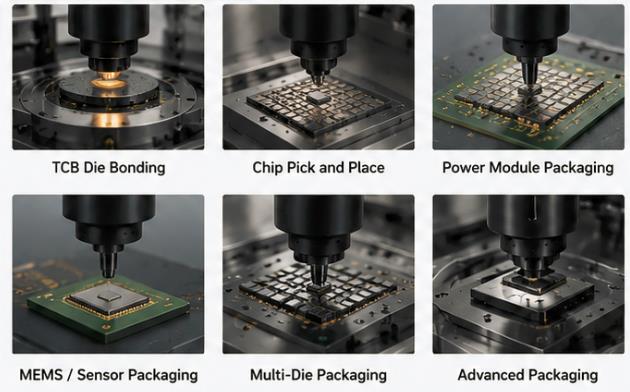
The nozzle typically performs four key functions: die pick-up, vacuum holding, alignment and heat transfer. A published TCB design describes a nozzle providing vacuum to pick up and hold a semiconductor die before aligning and attaching it to a substrate, demonstrating that the nozzle is an active process component rather than simply a mechanical holder.
Why Is Nozzle Flatness Important?
The flatness of the TCB nozzle directly affects the contact condition between the nozzle and die. If the bonding surface is not sufficiently flat, vacuum distribution and mechanical contact can become non-uniform, potentially affecting die positioning and bonding consistency.
Published TCB technology identifies nozzle flatness as an important requirement, and commercial TCB nozzle materials can achieve very smooth surfaces. For example, Coherent reports a surface roughness of <2 nm for its single-crystal SiC nozzle material, demonstrating the extremely fine surface finish that can be relevant to this application.
Why Is Silicon Carbide Used for TCB Nozzles?
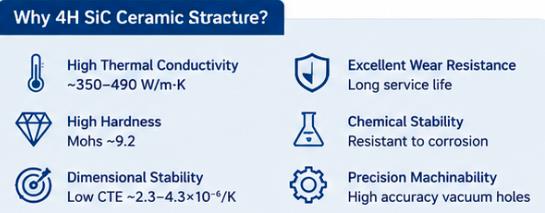
Silicon carbide is attractive for TCB nozzles because it combines thermal conductivity, mechanical rigidity, hardness and dimensional stability. These properties are important because the nozzle can be exposed to repeated heating, compression and vacuum holding during semiconductor die attachment.
Public technical information from Coherent lists single-crystal SiC at approximately 370 W/m·K thermal conductivity and describes SiC as suitable for finished TCB nozzles requiring smooth and flat surfaces. The same source compares reaction-bonded SiC, single-crystal SiC and polycrystalline diamond as materials for TCB nozzle applications.
Why Choose 4H-SiC for a TCB Nozzle?
4H-SiC is a single-crystal SiC polytype that can provide a combination of thermal performance and precision surface characteristics for TCB applications. Publicly disclosed TCB nozzle technology specifically identifies 4H SiC parts, confirming that 4H-SiC is an established material option for this component class rather than only a theoretical candidate.
The thermal conductivity of single-crystal SiC reported for TCB nozzle applications is approximately 370 W/m·K, while Coherent reports a surface roughness of <2 nm for its single-crystal SiC material. Actual values for a finished 4H-SiC nozzle depend on crystal quality, orientation, processing route, polishing and final inspection conditions.
4H SiC vs Other TCB Nozzle Materials
TCB nozzles can be manufactured from several advanced materials, including reaction-bonded SiC, single-crystal SiC and polycrystalline diamond. Public material data from Coherent reports thermal conductivity values of approximately 255 W/m·K for reaction-bonded SiC, 370 W/m·K for single-crystal SiC and 2,200 W/m·K for polycrystalline diamond.
The choice therefore depends on the required combination of thermal performance, surface finish, electrical properties, machinability and cost. For customers requiring a single-crystal SiC starting material, 4H-SiC polished plate provides a controlled material base for subsequent precision nozzle machining.
What Is a 4H SiC Polished Plate?
A 4H SiC polished plate is a single-crystal silicon carbide starting material that has undergone surface preparation to achieve a controlled polished condition. It can be supplied as a machining blank before the final vacuum holes, channels, mounting features and nozzle geometry are produced.
For TCB nozzle manufacturing, the starting plate can be specified by thickness, diameter, crystal orientation, surface roughness, flatness and machining allowance. Selecting an appropriate starting thickness can reduce unnecessary material removal when the final nozzle has a thickness of only a few millimeters or less.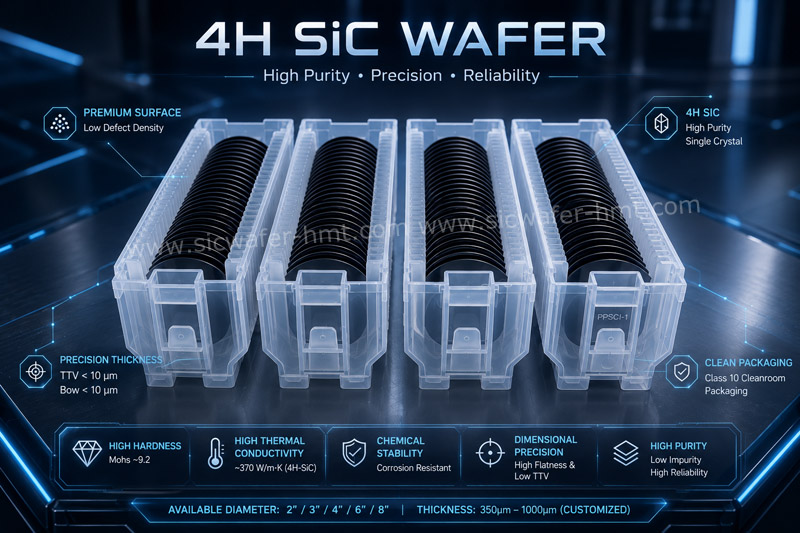
TCB Nozzle Applications in Advanced Packaging
TCB nozzles are used in processes involving semiconductor die attachment, flip-chip bonding and advanced packaging. The nozzle picks up and holds the die, maintains its position during movement and alignment, and participates in the thermal-compression bonding sequence.
TCB is particularly relevant to packages with fine-pitch interconnects, where alignment requirements can reach the few-micrometer range. Yamaha Robotics identifies narrow-pitch electrodes and high-speed mounting as important TCB requirements, while published nozzle designs address different die sizes and vacuum configurations.
HMT 4H SiC Polished Plate for TCB Nozzle Manufacturing
HMT supplies 4H SiC polished plate for precision-machined semiconductor equipment components, including customized starting materials for TCB nozzle manufacturing. Customers can specify the required dimensions, thickness, surface condition, crystal orientation and machining allowance according to their final nozzle design.
For customers producing TCB nozzles, HMT can evaluate the 4H-SiC polished plate → precision machining → vacuum structure → final polishing → inspection route based on a component drawing. This approach allows the starting material to be matched to the final nozzle geometry rather than using a one-size-fits-all SiC specification.
Request a Custom 4H SiC TCB Nozzle
If you are sourcing 4H SiC ceramic nozzles for TCB packaging, provide the nozzle drawing, die dimensions and required vacuum-hole configuration. HMT can evaluate the suitable 4H SiC polished plate, machining allowance, surface finish and precision-processing requirements for prototype or production projects.
For customers that manufacture their own final components, HMT can also provide 4H SiC polished plate as a controlled starting material for subsequent grinding, drilling, grooving and polishing. Contact HMT with your required dimensions and technical specifications for a customized quotation.
CATEGORIES
LATEST NEWS
- Introduction to the main functions of PbootCMS
What Is a TCB Nozzle? Materials, Vacuum Holding and SiC Nozzle Manufacturing
- Introduction to the main functions of PbootCMS
SiC : Industrial Ceramic vs Semiconductor Applications
- Introduction to the main functions of PbootCMS
How Does AI Help Singe Crystal SiC Boule Growth
- Introduction to the main functions of PbootCMS
Technical Analysis of SiC Wafer For Power Semiconductor Devices in New Energy Vehicles
CONTACT US
Contact: Mr.Kimrui
Phone:
Tel: Please send your detailed inquiry or requirements via email below.
Email: kim@homray-material.com
Add: Please send your detailed inquiry or requirements via email below.